I’ve had a lot of conversations with clients recently that go something along the lines of “I have a great team, but it feels like we spend more time figuring out who is going to do what than actually getting work done.” This is a perennial challenge with teams, but we’ve noticed that when budgets are stretched and the world is uncertain, who does what can feel less clear, just at the time when clarity is most important.
Over the next few months, I’m going to dive into one of the tools we use to help teams get unstuck: RASCI. I’ll talk about how we use it, what I like (and don’t like about it), and how using it changes the way people work together. But first, here’s some background on RASCI (If you already know this, skip to the end for tips!)
What is RASCI?
RASCI is a tool to help identify and communicate roles and responsibilities of people involved in a project. Teams use it to clarify who does what, who can help, who is responsible, and who makes decisions. RASCI is an acronym for five role categories on a project:
Responsible: Person responsible for completing an assigned task or project.
Accountable: Person with ultimate control over the project and resources
Support: People who help the Responsible team members complete the project.
Consult: People who give advice about the project.
Inform: People who need to be kept in the loop about the project.
These categories are useful for understanding where each team member fits within a project, including what is (and isn’t) their responsibilities. Clarifying the roles up front can help teams work more efficiently by removing unnecessary barriers to getting work done.
How do we use it?
High-functioning teams just seem to know who is going to do what, but we know they didn’t get there by accident. Here’s how we use RASCI to help teams do their best work.
When we start a new project with a client or internally, we fill out a RASCI with every team members’ role and sample activities. Depending on how complex the project is, we might have one RASCI that covers the whole project or we might need to go into detail for different activities and components of the work.
Take this simple RASCI for a cookie contest put on by our friends at Sesame Street. The project is fairly straightforward, there isn’t a ton of over overlap between the tasks, and they’ve had successful cookie contests in the past, so they can use a simple grid RASCI this:
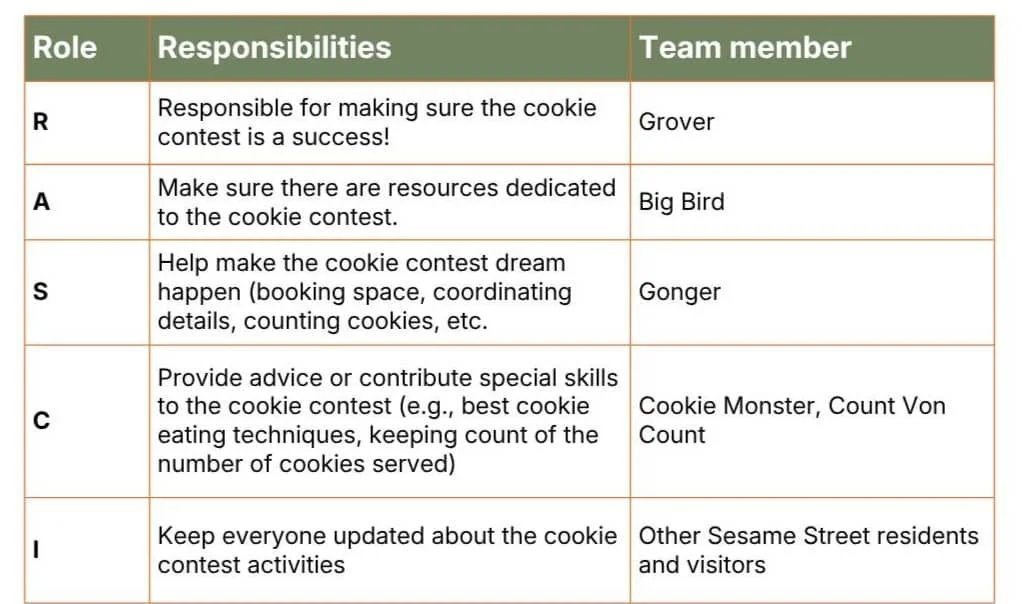
Cookie eating contest RASCI chart
When they aren’t sure who is responsible for a new task, they look at the RASCI to decide where it fits. Like when Oscar the Grouch said they couldn’t host the contest in front of his trash can, so they needed someone to find a new location. They could tell from looking at the grid that finding the location is Gonger’s responsibility, so he put it on his to-do list right away. Because they had figured out their roles in advance, they didn’t have to have a long discussion about who had time to add it to their list or who decides if they want to have it in front of Mr. Hooper’s Store. Instead, they got to get right to thinking about what types of cookies they wanted to serve.
RASCI in real life
Of course, most of our work isn’t as simple (or delicious) as a cookie contest. We work with collaborative teams that are juggling multiple cross-functional projects with extensive approval processes and a wide range of internal and external interest holders. When the work is complex, it is even more important to figure out the roles early, including getting really clear on who gives input, who makes decisions, and who is responsible for keeping the work moving forward. This can save hours of discussion and delegation time.
Tips
RASCIs work best when the team creates them together. Try dedicating 15-20 minutes during your next project meeting to discuss each team members’ role.
RASCIs are a tool, not a solution. Make sure the team refers to it regularly and updates it when the project changes.
If the role definitions don’t work for your team, you can use something else! In my next post, we’ll share more about how we customize RASCIs for different contexts.
Helping teams do their best work is our jam. If you have a team that is stuck in the “who’s job is that” trap, I’d love to talk!